STEP
ONE
Diagnose

See Clearly Before Trying to Fix Anything.
Most churches don't need more tools. They need to understand which problem they're actually trying to solve.
When something feels unhealthy, it's easy to jump immediately to a solution: restructure the staff, change a system, have another meeting, start a leadership program, or address the most visible conflict. But the problem you can see isn't always the problem that needs to be solved first.
That's why the Breaking Silos Church Health System begins with Diagnose.
Diagnosis creates a broad picture of the health of your organization before you begin prescribing solutions. Through a series of assessments, we look at the organization from several angles: leadership, culture, silos, pastoral health, team health, trust, and transparency.
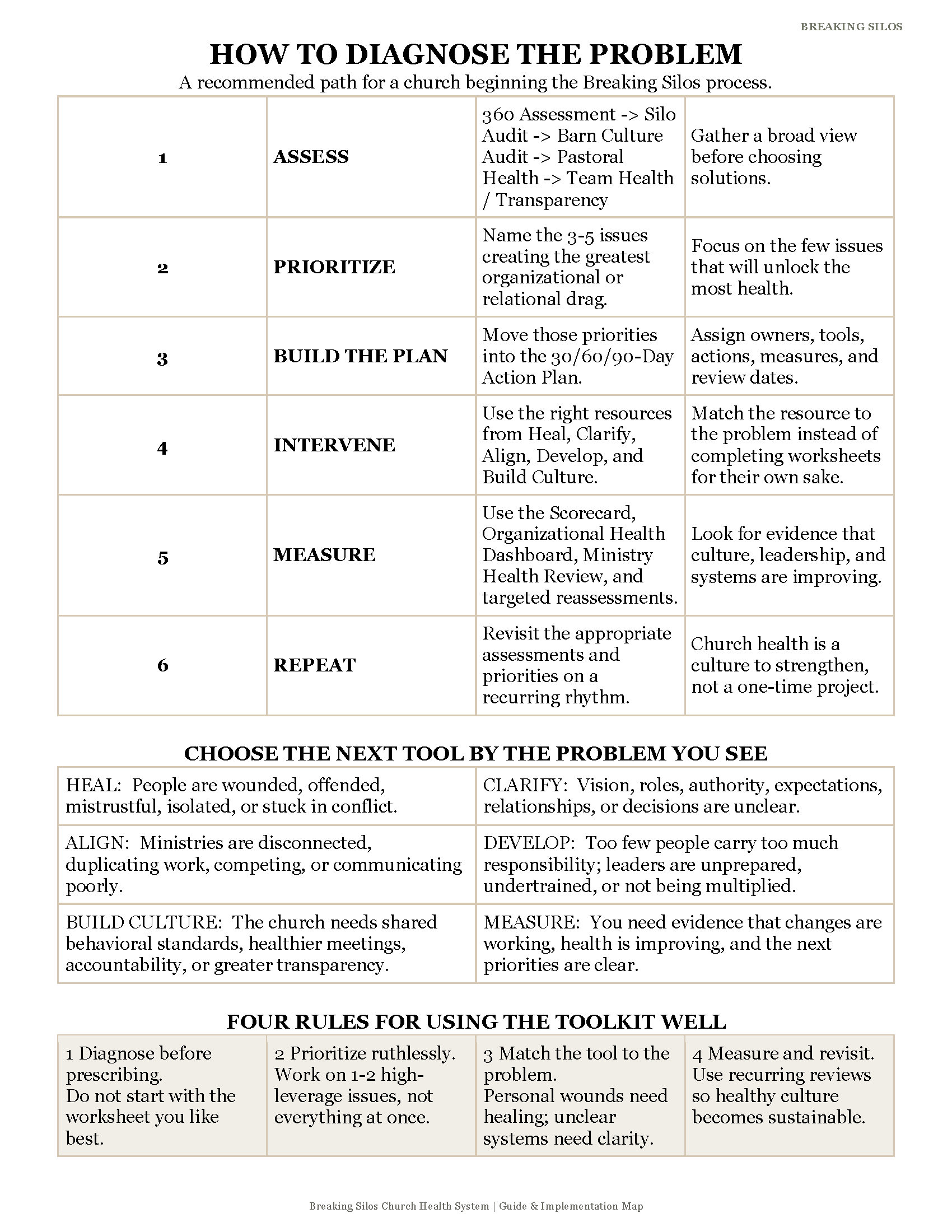
From there, the goal isn't to create an overwhelming list of everything that could be better. It's to identify the three to five issues creating the greatest organizational or relational drag, then prioritize the one or two areas where focused attention can create the greatest movement toward health.
Once you understand what you're actually dealing with, you can choose the right tools from Heal, Clarify, Align, Develop, and Build Culture, establish a plan, and eventually measure whether anything is really changing.
Diagnose before prescribing. Don't start with the tool you like best. Start with the problem that needs your attention most.
Diagnostic Tools
-

360 Degree Assessment
Start with the big picture.
The 360-Degree Organizational Assessment gathers perspectives from across the organization to provide a broader view of its health. Rather than relying on the perspective of one leader or department, it helps uncover patterns, strengths, blind spots, and areas of concern that may look very different depending on where someone sits in the organization.
-

Silo Audit
Find where walls are forming.
The Silo Audit identifies where ministries, leaders, or teams may be becoming isolated from one another. It examines communication, collaboration, territorial thinking, shared ownership, and whether individual areas are working toward the same mission or increasingly operating on their own.
-

Barn Culture Audit
Discover the culture you're actually building.
The Barn Culture Audit evaluates whether your church is creating an environment of shared mission, trust, collaboration, responsibility, and mutual support. It helps reveal the difference between the culture you intend to have and the behaviors your organization is actually reinforcing.
-

Pastoral Health Checklist
The health of the church and the health of its leaders are connected.
The Pastoral Health Checklist gives pastors an opportunity to honestly evaluate their own health, leadership pressures, relationships, support systems, and areas of vulnerability. Organizational problems aren't always structural. Sometimes the leader carrying the organization needs attention too.
-

Team Health Assessment
Look beneath team performance.
A team can accomplish tasks while still becoming unhealthy. The Team Health Assessment examines your team's relational and functional health, helping you identify issues around trust, communication, conflict, accountability, collaboration, and how people work together.
-
Team Transparency Assessment
Find out whether people can actually tell the truth.
Healthy organizations need people who can raise concerns, admit mistakes, disagree, ask difficult questions, and talk honestly about what isn't working. The Team Transparency Assessment helps reveal whether your culture makes honesty possible or whether people have learned that silence is safer.
-
30/60/90 Day Action Plan
Turn diagnosis into action.
The 30/60/90-Day Action Plan is the bridge between identifying what's unhealthy and actually doing something about it. After completing the diagnostic process, leaders choose the three to five highest-priority issues, determine which need attention first, and build a focused plan for moving forward.
For each priority, the plan establishes who owns it, which Breaking Silos tools to use, what needs to happen over the next 30, 60, and 90 days, how progress will be measured, and when the team will review the results.
What Happens After Diagnosis?
gnosis?After completing the appropriate assessments, leaders identify the three to five issues creating the greatest organizational or relational drag and prioritize the few issues that will produce the greatest movement toward health.
Those priorities move into the Breaking Silos 30/60/90-Day Action Plan, where you assign ownership, select the appropriate tools, establish actions and measurements, and set a date to review progress.
What happens next depends on what the diagnosis reveals:
HEAL when people are wounded, mistrustful, isolated, offended, or stuck in unresolved conflict.
CLARIFY when vision, roles, authority, expectations, relationships, or decisions are unclear.
ALIGN when ministries are disconnected, competing, duplicating work, or communicating poorly.
DEVELOP when too few people carry too much responsibility or leaders aren't being prepared and multiplied.
BUILD CULTURE when healthier behaviors, accountability, meetings, standards, and transparency need to become normal.
MEASURE to determine whether the changes are actually producing healthier leaders, teams, culture, and systems.
And then you repeat the process.
The goal of diagnosis isn't to discover everything that's wrong. It's to discover what needs your attention next.